Guest article by Kelvin Bergsma, swimming coach at Dedemsvaart AC, the Netherlands
In competitive swimming, technique is everything. Coaches can provide feedback on body position, stroke mechanics, or streamline, but true understanding often comes when swimmers can actually see themselves moving through the water. With that idea in mind, we set out to create a practical solution that would allow swimmers to review their technique immediately during training sessions.
The result is a mobile underwater video analysis setup consisting of a GoPro camera, an iPad 11th Generation with the A16 chip, and the Video Delay Instant Replay app. Together, these components allow us to provide near-instant feedback without the complexity and cost of professional swimming analysis systems.
About Dedemsvaart AC
This project originated from the day-to-day training environment of Dedemsvaart AC, a Dutch swimming club founded in 1967 and affiliated with the Royal Dutch Swimming Federation (KNZB). Dedemsvaart AC competes at regional, provincial, and national championships. The club also competes in the Premier Division (Hoofdklasse) of the Dutch National Swimming Competition, the highest level within the Dutch club competition structure.
Throughout the season, our swimmers compete in national qualification meets, Dutch National Championships (NK), and Dutch Junior National Championships (NJK). The combination of athlete development, daily training, and technical coaching forms the foundation of our competitive swimming program.
Because technical development plays such an important role at this level, we are constantly looking for new ways to improve the quality and effectiveness of our training sessions.
Our Design Goals for an Underwater Video Analysis System
When developing the system, we had several clear objectives:
- Provide immediate visual feedback during training.
- Deliver high-quality underwater video.
- Maintain a reliable connection between the camera and the iPad.
- Create a setup that is easy to transport and deploy.
- Allow the coach to move alongside swimmers.
- Build an affordable alternative to professional swimming analysis systems.
We quickly discovered that the biggest challenge was not the camera itself, but maintaining a stable wireless connection underwater.
The Hardware and Software
At the heart of the system is a GoPro camera mounted inside a modified underwater housing. The camera provides high-quality footage and can be used to capture critical technical elements such as:
- Body position
- Stroke mechanics
- Kick technique
- Breathing patterns
- Streamline position
- Starts
- Turns
For video processing and review, we use an iPad 11th Generation powered by Apple’s A16 chip. The iPad offers more than enough performance for smooth video playback and a screen large enough to review footage directly with swimmers at poolside.
Connecting everything together is the Video Delay Instant Replay app. The app allows us to view footage with a preset delay, eliminating the need to manually record, save, and replay videos. Footage becomes available almost instantly during the training session.
A Creative Solution for Underwater Wi-Fi
During development, we encountered a well-known challenge: Wi-Fi signals perform very poorly underwater. This makes a direct wireless connection between an underwater camera and a tablet highly unreliable.
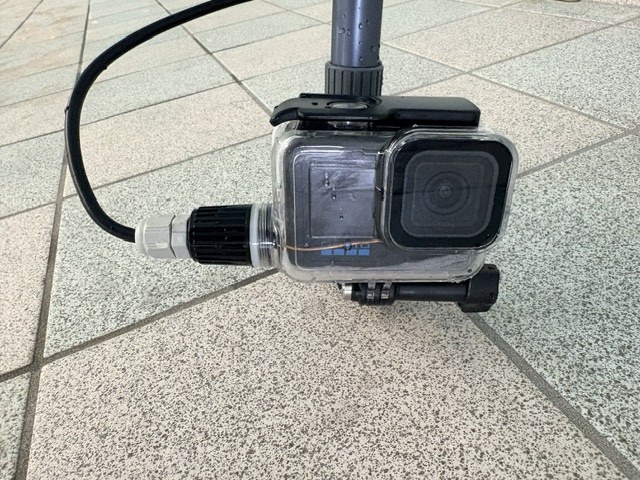
To address this, we modified the underwater housing and incorporated a coaxial cable system that carries the wireless signal from below the water surface to above it.
Photos 1 and 2 show the modified GoPro housing. On the left side of the housing, a cable gland allows the coaxial cable to exit the enclosure. Inside the housing, the wireless signal is captured and routed through the coaxial cable to the surface.
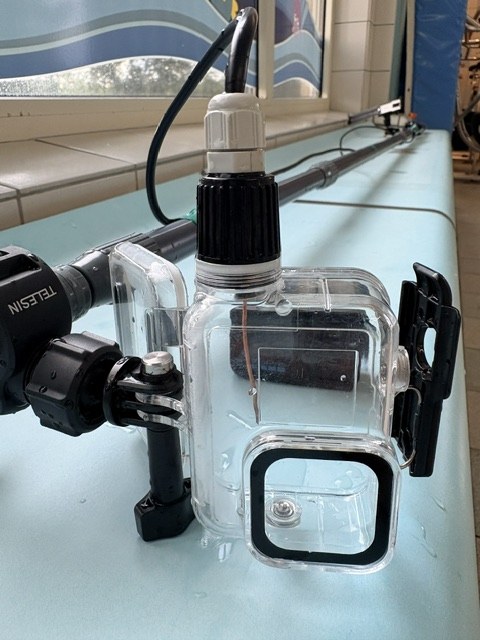
Above the water surface, the coaxial cable is connected to an external antenna that receives and transmits the Wi-Fi signal to the iPad. This means most wireless communication happens above the water, where signal strength and stability are significantly better. Photo 3 shows the external antenna mounted along the camera pole.
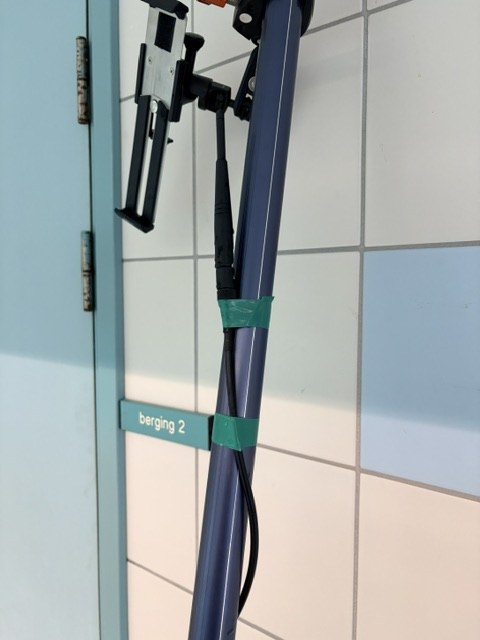
This solution allows the GoPro to remain fully submerged while maintaining a reliable wireless connection to the iPad.
From Fixed Camera to Mobile Analysis
In addition to improving connectivity, we wanted greater flexibility during training sessions.
To achieve this, we developed a mobile camera platform using a long telescopic painting pole. Mounted on the pole are:
- The GoPro camera
- The modified underwater housing
- The external antenna
- An iPad holder
- The required cabling
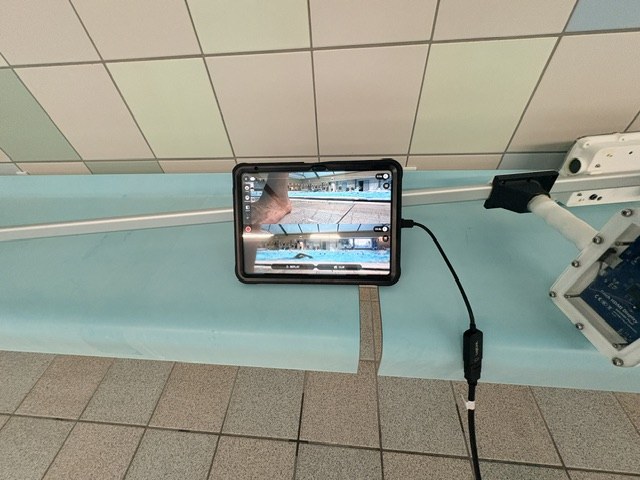
Part of this construction is visible in Photo 3, where both the antenna and tablet mount can be seen attached to the pole.
This design enables us not only to film from a fixed position, but also to walk alongside swimmers as they move down the pool. As a result, swimmers remain in view over a much greater distance, allowing for more detailed technical analysis.
The mobile setup can easily be adapted for:
- Underwater stroke analysis
- Start analysis
- Turn analysis
- Dynamic tracking throughout an entire lane
How We Use the Setup During Swimming Training
During a typical training session, the camera position depends on the coaching objective. Sometimes the camera remains stationary to focus on a specific technical aspect. In other situations, the coach walks alongside the swimmer while filming.
As the swimmer moves through the water, footage is transmitted live to the iPad running Video Delay Instant Replay. Thanks to the programmed delay, swimmers can review their performance immediately after completing a drill or set.
This significantly shortens the learning cycle. Swimmers can connect what they felt in the water with what they see on the screen only moments later.
In practice, this helps swimmers better understand:
- Their body position in the water
- Stroke mechanics
- Sources of drag and resistance
- Streamline effectiveness
For coaches, the system provides objective visual evidence that makes technical feedback more precise and easier to understand.
Large-Screen Viewing
During training sessions, we do not rely solely on the iPad display. We also use a television at poolside.
At present, the iPad is connected to the television using an HDMI cable. The reason is simple: reliability.
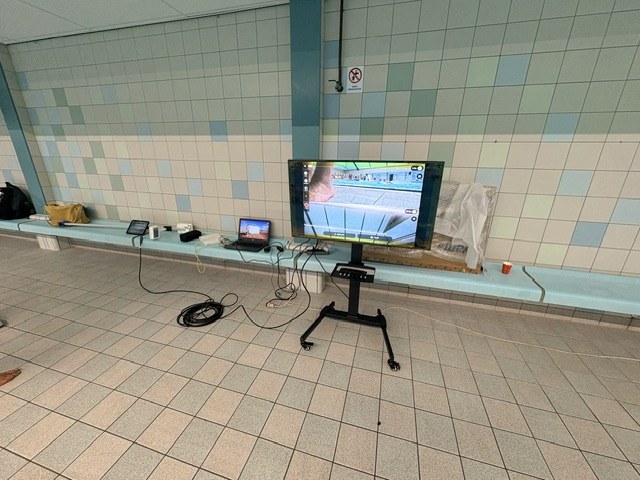
When providing immediate technical feedback, we want to avoid interruptions, latency, or connection issues. The wired HDMI connection consistently delivers a stable and dependable viewing experience.
An additional advantage is that multiple swimmers can review the footage simultaneously, creating opportunities for group learning and technical discussions.
What Makes Our Underwater Video Analysis System Unique
What started as an experiment has evolved into a system that is now a regular part of our training program.
What makes the setup unique is that it was developed entirely from practical coaching challenges rather than from a desire to build a complex technology project. Instead of investing in expensive commercial systems, we combined readily available components:
- A GoPro
- An iPad
- Video Delay Instant Replay
- A modified underwater housing
- A coaxial Wi-Fi solution
- A telescopic pole
- An external antenna
The result is a mobile, affordable, and highly flexible system that can be used in virtually any swimming pool.
Future Plans
Although the current setup performs extremely well, we continue to look for opportunities to improve it.
In the short term, we are focusing on further optimizing the wireless workflow. At present, we deliberately use an HDMI connection between the iPad and the television because of its excellent stability. However, we are evaluating whether a fully wireless solution using the Orion Prime Wireless USB-C to HDMI Transmitter & Receiver can offer the same level of reliability.
We also plan to further refine the modified underwater housing and antenna system. Our goal is to simplify the setup process while improving signal quality and overall usability.
More importantly, we want to integrate video analysis even deeper into our daily coaching environment. Rather than treating analysis as a separate activity, our aim is to make instant visual feedback a natural part of every training session.
The combination of GoPro, iPad, and Video Delay Instant Replay has demonstrated just how powerful immediate visual feedback can be. What began as a practical experiment at poolside has grown into a valuable tool for swimmer development. By making technology accessible, mobile, and easy to use, we can help our athletes learn faster, train smarter, and ultimately perform at their best. That is why we will continue to develop, test, and improve this system in the years ahead.
Further Reading
For coaches who want the research behind this, a recent review article summarizes what is known about video feedback in sport and athlete development, and highlights the importance of active reflection and coach–athlete interaction when video is used as a learning tool. That closely aligns with the way we use Video Delay Instant Replay during swim training.
- Pearson, A., Webb, T., Milligan, G., & Miller-Dicks, M. (2025). The use of video feedback as a facet of performance analysis: an integrative review. International Review of Sport and Exercise Psychology, 18(1), 417–439.
A second review may be valuable especially for coaches working with youth athletes. It concludes that video-based visual feedback appears to support motor learning and may offer advantages over verbal feedback alone. It is focused on physical education, but many of the findings are highly relevant to youth sports coaching.
- Mödinger, M., Woll, A., & Wagner, I. (2022). Video-based visual feedback to enhance motor learning in physical education: a systematic review. German Journal of Exercise and Sport Research, 52(3), 447–460.
Finally, a personal source of inspiration. My own interest in video feedback was sparked by a Dutch publication, Van tikken naar taggen. Its chapter “Digitale video en (zelf-)modellering in de gymles”, by Marjan Kok and John van der Kamp, introduced me to self-modeling, where athletes learn by observing and reflecting on their own movements on video. The book is written in Dutch, but many of the ideas in it are reflected in how we use Video Delay Instant Replay today.
- Van Hilvoorde, I., & Kleinpaste, J. (Eds.) (2014). Van tikken naar taggen: digitalisering van bewegingsonderwijs en sport. Deventer: daM uitgeverij. Chapter: Kok, M., & Van der Kamp, J., “Digitale video en (zelf-)modellering in de gymles”, pp. 27–41.
Looking back, self-modeling is exactly what happens at our poolside: the swimmer is the model, the footage is their own, and the reflection happens while the feel of the last length is still fresh.